When you burn your hand on a pot handle

dad cooking

Somehow, this is easy to do. For me, it happened when a burner I’d accidentally turned on heated the handle of the pot that was sitting on the burner I’d meant to turn on. I won’t go into details. Bottom line: I full on grabbed a piping hot metal pan handle and scorched the surface of my palm.

When I looked on the internet for specific solutions to this problem, there were plenty of headlines about grabbing a hot pot handle, but I was taken to generic burn instructions that didn’t necessarily speak to my issue. However, I sifted through them to find some sort of pain relief and strategies to limit blistering. I have compiled this list of relevant and helpful guidelines for addressing this specific problem.

First, take off jewelry. Your hand is going to get puffy and red. It’s going to feel like the worst sunburn you’ve had.

Second, run hand under cold water faucet. Experts say 10-15 minutes (click for link). If you fully grasped the pot/pan handle, you’re going to need more time than this. I felt bad about wasting water, so I put cool water in a bowl and just moved my hand back and forth.

If possible, take an ice pack out of the freezer and let it sit out at room temperature during this time.

Third, stay away from putting stuff on your hand. I tried a few products with aloe in them and then just straight aloe, and each one seemed to intensify the burning. Though internet searches said these would help, anything that covers the burn limits its ability to dissipate heat. Cool water is best.

Fourth, the cooled ice/water pack is helpful for moving about. Ideally, this wouldn’t be an ice pack because very cold temperatures on the skin after a burn can further damage tissue (see link here). When my pack was a bit too icy, I wrapped it in a towel that made it feel the temperature of cool water.

Fifth, if this happens at night, sleep at the edge of the bed with your hand in a bowl of cool water sitting on something below bed height (chair, tiny table, etc.). I tried this two ways, first on my back with my left (burned) hand off the left side of the bed. This is tricky because I had burned my palm and had to turn my arm in an awkward position. The second way worked better for me. I laid on my right side and let my left hand rest in the bowl of water that was on the right side of the bed.

When I woke up the next morning, my pain had subsided and my hand was out of the bowl.

Sixth, if there are no blisters, leave hands bare. While the rest of the day there were still some hot spots (pre-blister) on my hand, they were mostly gone, at least smaller, and healing quickly.  If there are blisters, don’t pop them and keep them covered to reduce risk infection (see link here). I didn’t have this issue, but I trust traditional first aid knowledge at this point.

Luckily, our skin is amazing (see here) and can heal quickly when we take care of it. Give it some TLC while its healing, and you’ll be back in business in no time.

How to Write a Reflexivity Statement (for professional or personal purposes)


One little trick can help you gain more accurate research results, improve personal relationships, and avoid professional pitfalls. All it takes is answering questions you inherently know the answer to and then taking a few steps to make those answers useful.

How do you see the world? What paradigms structure your life? How are you influenced by the people and places around you? And vice versa?

These questions are part of what are answered with a reflexivity statement. They are crucial to understanding yourself and your place in the world around you. In research, best practices mandate that you write a reflexivity statement before penning a proposal  or stepping into a community.  You must understand why you are asking particular research questions, how your perspective may be limited, and how you may be prone to bias. Though knowing your inner workings does not prevent them from playing a role in research outcomes or conclusions, it does help to limit their influence and gives you the power to correct for your own shortcomings. Continue reading

Things You Use & Things You Use Up

Tags

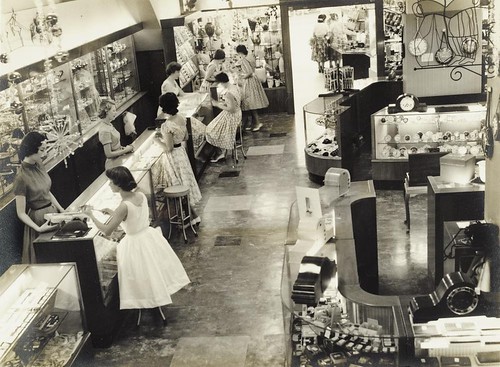
Section of the main showroom inside F. W. Nissen jewellery store in Brisbane, Queensland, ca. 1950

The American shopping tradition circa 1950. It’s legacy lives on today in the most extravagant forms.

“Goods fall into two classes: those that we use, such as motor cars or safety razors, and those that we use up, such as toothpaste or soda biscuits. Consumer engineering must see to it that we use up the kind of goods we now merely use.”

-Earnest Elmo Calkins, author of Modern Marketing

In June Cleaver’s era, Americans shifted from scraping and saving everything they could during depression and war times to consuming as much as possible. Government saw consumerism as a need to build the economy, and Calkins’ call for convenience and consumption reigned high. Marketers worked to send the message that the way to solve problems in life was to consume. June and other television housewives worked as models in what were effectively half hour long infomercials to display the new role of the woman and all the things she needed to do and have to fulfill that persona. Today, America’s consumer culture continues, building and refining Calkins’ message. Continue reading

Aside

3 Enthralling and World-Widening Reads

Despite a lifetime of history and social studies, I managed to remain ignorant about the ways of the not-too-distant rest of the world. In our little American island, I suspect the majority of us know little more than bare basics about world cultures and history.  Hearing first hand stories of people from different countries and times tremendously helps add detail and life to our hollow knowledge.

These are three books I’ve stumbled upon recently that each opened my eyes to other cultures and world events.  They’re all beautifully crafted books that take place in roughly the same time period (1940’s-present day). They masterfully paint a picture of the human side of the political unrest that still profoundly affects the Middle East and Eastern Europe. Continue reading

Brave, Brave, Brave

A little over a month ago I was listening to public radio when I came across my now favorite quote of all time.  It was spoken by the leader of the wildly successful all female brass band, the Pinettes, who have recently been named “Street Queens” by beating out all of the male dominated bands in the Street Kings brass band competition.  Members of the group collaboratively spoke of their journey to build and keep the group together.  At one point, they got to a part about when the group almost fell apart. Hurricane Katrina and its aftermath had struck the group hard, and many members were forced to move away, including band leaders.  Those who remained were determined to keep their band going, so with new leadership, they recruited, rehearsed, and rebuilt. Continue reading

Two-Sentence, Twenty-Second Technique

img2217

Belle of the Ball! Engage anyone you talk to by keeping your message short and sweet and by listening carefully when they respond.

When we picture ourselves captivating an audience at a party, we envision people crowded around laughing at punchlines and nodding their heads in agreement with our intelligent arguments. Unfortunately, sometimes these grand plans fall short. Laughter may not come quite when or where we intend or heads nod more from boredom than understanding. If we want to avoid the blank stares that come at the end of ineffective speaking, there is a very precise solution.  Keep it short, and allow those listening interact before adding more.

Evidence shows that while the mind picks up a substantial amount of information, much of it is stored in the harder to access long-term memory, so limited amounts are available for immediate use. Specifically, the typical mind can hold four pieces of information for thirty seconds. So when you’re rambling on for hours, hashing out all the details of an ingenious plan or explaining the minutiae of your date night, there’s a great chance that your audience isn’t comprehending what you want them to.

The solution is simple, but it takes a concerted effort and eight weeks of practice.  Only speak for twenty to thirty seconds at maximum, limiting yourself to two sentences.  This does a few things. First, it limits the information you give to only the most important.  This way, the superfluous details are left out and can’t distract from your main point.

Second, it allows the listener to comprehend everything you say. When they respond, you can see if they understood what you were trying to say, and they can ask for clarification on what wasn’t clear.  If you need to relay essential information, break it up even more into ten-second pieces.  Once you have feedback, you can continue and/or respond to their message.

The third thing it does is limit negativity.  In conflicts, we can work ourselves up when we have complete freedom to ramble on about everything that we aren’t happy with.  By condensing our communication, we force ourselves to leave out negative emotions, which, just like other emotions, are reinforced and deepened the more we vocalize them.

The twenty-second, two-sentence technique is part of the “Compassionate Communication” strategy developed by Andrew Newberg, M.D. and Mark Robert Waldman, experts in the medical research and executive communication fields, respectively.    Their communication techniques are tested and supported so much that many corporations and businesses integrate brevity in communication into their culture.  Some CEOs require important information or questions be submitted on index cards. Others meet for morning meetings and give each department head one sentence to relay information from their department.  Though succinct speaking techniques are utilized in the business environment, they are supported in all aspects of communication.

This one communication tactic can deepen understanding and decrease conflict in romantic relationships if each partner participates.  When we limit our communication to short periods of talking and interested spans of listening, we control what messages we send, understand how they are received, and strengthen the connection between ourselves and our audience.

Snaps, An Insider Game

Eleanor Roosevelt with student service group, Seattle, May 5, 1941

Everyone wants to play Eleanor’s game. This group of students were probably trying to figure out the first lady’s snaps.

Since we know how fun innocently tormenting others can be, let’s play a game that will drive everyone nuts.  The key is that at least one person other than yourself has to know how the game works and one person has to be clueless to it all.  Then hype up how fun it is so that everyone who doesn’t know the trick wants to play. Continue reading

Favorite Icebreaker: Favorite Things

One of my college English teachers always had us “warm up” with writing drills before class.  She’d write a prompt on the board and we’d spend a few minutes writing it in our journal.  The other day I stumbled across one of those entries entitled “My Top 10 Favorite Things,”  which I kinda got a kick out of. It was a list of my top 10 favorite things in the world, excluding people. Most of them still rang true. Continue reading

Power Off

Just before I moved to California, I was going stir crazy.  I was taking live, in-person classes that included a substantial amount of time spent on the computer for online reading material, online “discussions”, and typing up papers.  I felt like my life was being wasted away in front of a screen.  My dreams began to take the shape of me decisively throwing my computer in the ocean and living on the beach in a sort of simple, real existence.

Remembering that, it’s hard to reconcile the substantial amounts of data usage and screen time I use on a daily basis.  For so long I only wanted to escape technology’s hold on me, but now I electively carry around mini computers in the form of a tablet, mp3 player, and smart phone. Continue reading

Cute Never-Fail Jokes

Finally, a girl with a sense of humor! These guys aren’t going anywhere!

Cute Jokes

  • A bear walks into a bar and says, “I’ll have a rum and…” after a few seconds continues, “coke.” The bartender pours the drink and gives it to the bear.  The bear comes back again and says, “This time I’ll have a gin and…” waits a few seconds before finishing, “tonic.” The bartender again complies.  The bear comes back a third time and orders.  “Can I have a vodka and…” he waited even longer this time, “cranberry?”  The bartender responded, “Sure, but what’s with the big pause?” The bear looks down, shrugs his shoulders and says, “What these? I’ve had them all my life.”
  • What did the fish say when he hit the wall? “Dam!”
  • What did the bra say to the hat? “You go on a head. I’ll give these two a lift.” Continue reading